

YUKIKO KASHIWAGI × MICHINO PARIS — Beyond a Long Story
 Designer & founder
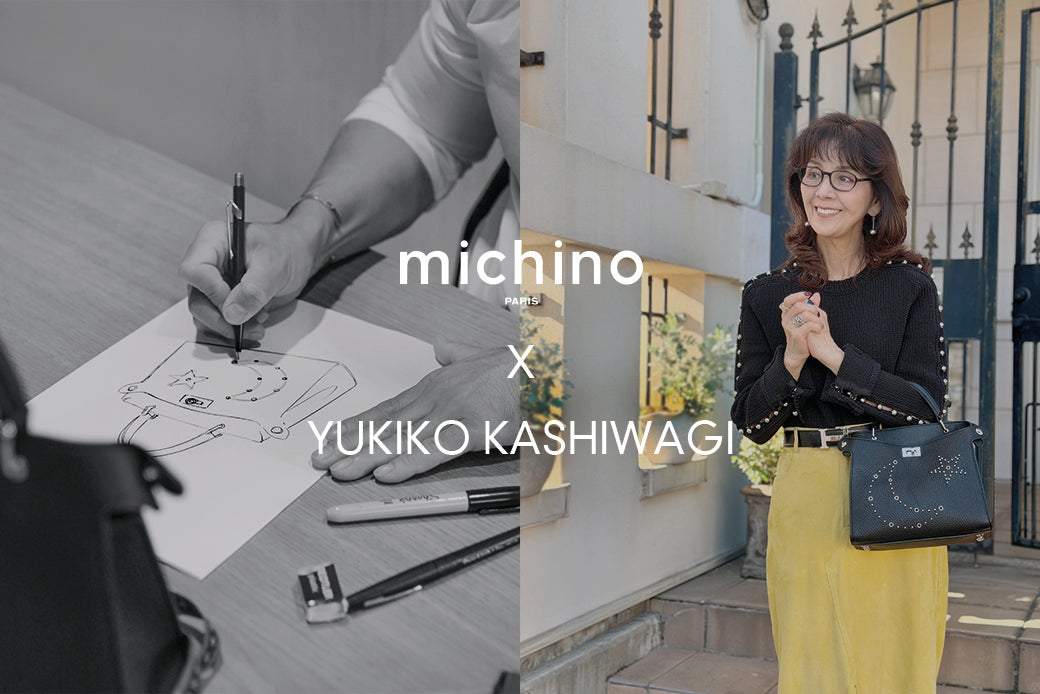
Actress Yukiko Kashiwagi trusts her intuition and her own aesthetic sense, and enjoys fashion in everyday life with elegance and a light touch.
A special collaboration between Michino Paris and Yukiko Kashiwagi has now come to life. Made possible by her meeting with designer Yasu Michino, it is a one-of-a-kind project: bringing back to life a long-lost bag she has dreamed of reviving for forty years.
In this special conversation, two people who share a love of fashion and craftsmanship talk about the stories behind the collaboration and the appeal of the bags.

Kyu Sakamoto and the Joy of Making
— Your memories of life with your husband, Kyu Sakamoto — one of Japan’s most beloved singers — remain close to your heart. We hear he loved making things by hand, and that the two of you often created things together.
Kashiwagi: That’s right. My husband was always good with his hands. He made me Kasama-ware plates and sake cups, small leather goods, and much more. We both simply loved having fun, so we would bounce playful ideas off each other and make all sorts of things. Bags were one of them. The first was a quirky one: a vinyl flap filled with blue water, with a little doll swimming inside. He enjoyed it too — “Isn’t this fun?” he’d say. We even sold it in boutiques in Harajuku.
— Does the “light-up bag” that inspired this collaboration also hold memories of the things you made together?
Kashiwagi: For our second bag, the light-up bag was something I simply had to try making. My husband found it amusing and supported me in all kinds of ways, including the paperwork to register the design. Light bulbs were hidden inside eyelets shaped like moons and stars, and they twinkled. His driver, who was very handy, helped make it. Above all, it’s a memory of everyone having fun making it together.
— First enjoying something wholeheartedly yourselves, then brightening the people around you: that spirit echoes the music of Kyu Sakamoto, a born entertainer. Yasu, what did you feel when you saw the original bag from forty years ago?
Yasu: Seeing it reminded me of my early days as a designer at Saint Laurent and Sonia Rykiel, when I was shown archive bags from the ’70s and ’80s. The velvet texture and the tassels capture the trends of that era, yet there is something timeless and classic about it. And the use of studs, the idea that it lights up — there’s a touch of fantasy in it. I felt it was so characteristic of Ms. Kashiwagi’s playful spirit.

WHERE THE INSPIRATION CAME FROM
— Where did the unique idea of a bag that lights up come from?
Kashiwagi: I found the inspiration in Las Vegas. Some people were wearing earrings and bow ties that lit up, and I thought, “I love the way they light up like that!” That was the start. I rushed to a DIY store (Tokyu Hands) myself to buy light bulbs, went around several shops to have stones set… It took a lot of trial and error.
Yasu: I grew up in an environment where we didn’t have many things, so I made things using paper, scissors, pencils and paper cartons, letting my imagination run free. That urge — “I just have to make this!” — is what drives ingenuity and nurtures creativity.
THE LONG-LOST “LIGHT-UP BAG”, AND THE WISH TO BRING IT BACK
Kashiwagi: Once the bag was complete, I gave it to my friends Tetsuko Kuroyanagi and Sayuri Yoshinaga, two of Japan’s most celebrated stars, and it was even featured in the newspapers. But my husband passed away before we could take it further, and the bag faded into memory.
For forty years I held on to the wish to see it properly completed one day. Recently I tried to recreate it, but today’s LEDs were far too bright — it was like walking around carrying a fluorescent tube. “There’s no magic in that,” I thought, and I gave up.
— Ms. Kashiwagi was already a fan of Michino Paris bags, and Yasu had admired, through social media, the way she dresses and coordinates her bags. How did your paths cross?
Yasu: One day my mother in Japan sent me a link to a clip from Tetsuko’s Room (Tetsuko no Heya), the long-running TV talk show hosted by Tetsuko Kuroyanagi. “Ms. Kashiwagi — who always carries Michino — is showing a lovely bag on the show,” she said. Michino tends to let simple shapes and materials speak for themselves, but Ms. Kashiwagi’s bag had fantasy and playfulness, with Swarovski crystals and light. I was strongly drawn to it: “I’d love to make something like this — something I could never create on my own!”
Above all, I was moved by the bond between husband and wife described on the show. I felt that by bringing the forty-year-old bag back to life and passing on its story, her memories with Kyu Sakamoto would live on. So I proposed reissuing the light-up bag.
Kashiwagi: I first came across Michino Paris while shopping: “What a lovely bag! Whose is it?” I wondered as I picked it up. Wonderfully functional, very light, with an ideal design and size. As for the light-up bag, I’m truly happy that meeting Yasu has allowed it to see the light of day again.
Yasu: As a designer I can create the shape of a bag, but I can’t create a person’s own story. If Michino made moon and star motifs on its own, they would just be cute. What gives an object meaning is the strong feeling behind it. I was certain that when her feelings and the path she has walked came together with our design, we would create something wonderful.

DESIGN DETAILS AND THE MEANING OF THE MOTIFS
— Unlike past collaborations, where you designed a new shape from scratch, this time you chose Michino models that already define the brand (Lutèce, Odéon, Étoile). Was there a particular reason behind that choice?
Yasu: We deliberately didn’t create a new shape because we wanted to bring together two stories as they are: Ms. Kashiwagi’s — an idea from forty years ago and the bond of a married couple — and Michino’s, the shapes and materials the brand has built up over the years. That way, the essence and history of each blend in the best possible way. “The beauty of things that have aged well transcends time and looks new again today” — that theme is also part of this collaboration.
— The motifs Ms. Kashiwagi designed forty years ago have been faithfully reproduced. What message does each one carry?
Kashiwagi: I didn’t choose the moon, the star and the heart simply because I like them. On the Odéon, a single star stands for “HOPE”; on the Lutèce, the moon and star together stand for “HARMONY” — harmony and the bonds between people. I hope that whoever carries the bag never forgets hope and treasures their connections with the people who matter — family, friends, a partner. And the heart on the Étoile is, of course, “LOVE.” I’d be happy if carrying this bag brings you a loving, positive feeling.

Yasu: Kyu Sakamoto’s signature songs, Miagete Goran Yoru no Hoshi o (“Look Up at the Stars at Night”) and Ue o Muite Arukō (known worldwide as “Sukiyaki”), really evoke the moon and the stars. And it’s precisely because you look up that you can see the moon and stars in the sky. Whatever happens, keep looking up at the sky and stay positive — I realized that’s the message carried by the motifs Ms. Kashiwagi imagined.

— The moon, the star and the heart are familiar motifs, but hard to make distinctive as shapes. Yet these have real character and a charm you won’t find elsewhere.
Yasu: It’s true that everyone in the world knows these motifs. A clear message is a strength, but depending on the design, you can end up with shapes that all look “the same.” Yet in all my years designing for various houses, I had never seen a moon, star or heart like these. They seem familiar, yet they are a genuinely new idea. Rather than a single continuous line, they are drawn in dots — rows of studs and eyelets (Swarovski crystals for the heart). Like constellations in the night sky, the shape of the moon, the star or the heart comes together as the viewer connects the dots.
Kashiwagi: Exactly. The heart on the Étoile is dotted with Swarovski crystals in five colours, and the result has a grown-up kind of cuteness. It turned out truly lovely.

Yasu: We can’t hide light bulbs inside like forty years ago, so to recreate the sparkle of the original light-up bag we paid particular attention to using multicoloured Swarovski crystals. We considered a single colour, but this felt closer to the image of twinkling bulbs.
— Bags with motifs can seem hard to wear, but because they are drawn in dots of studs rather than lines, they add a refined accent naturally, even to a classic, conservative outfit.
Yasu: Exactly. It doesn’t overstate itself, but adds a little change and sparkle to classic wardrobe staples. It’s as if the bag itself is inviting you: “How about trying this style?”
YUKIKO KASHIWAGI’S WAY OF STYLING
Yasu: In fact, the most important part of design work is “editing” — selecting with the occasions of use in mind. However good an object is, nobody needs it if there’s no occasion to use it. We could have offered many colourways, but Ms. Kashiwagi, with her refined aesthetic sense, brilliantly edited the range down to three styles and three colours (black, gold and Craie) that suit any occasion.
— What are your favourite ways to style them?
Kashiwagi: All three colours and shapes are really easy to style with your outfits, and work for both casual and elegant looks. Gold is a colour I love, so I was set on making it. I pair the gold Odéon with a suede jacket, or the black Lutèce with a black top and a yellow skirt. The Étoile in Craie has a sweet feel, but it also looks great with denim and casual outfits. I switch between them every day myself — deciding which one to pair with my outfit has become one of my little daily pleasures.
Yasu: The Étoile will be delivered in January, so it’s perfect for bringing everyone a first hint of the coming spring. And with its colourful Swarovski crystals, it’s ideal for the summer beyond.
AFTER THE COLLABORATION
Yasu: Actually, I recently lost my father. Ms. Kashiwagi lost Kyu Sakamoto forty years ago. Thinking about that, I feel how important it is to keep hoping, even through hard times. I hope people will love these bags not as mere products, but knowing the story behind them, as a kind of good-luck charm that brings hope to everyday life.
Kashiwagi: Thanks to this wonderful encounter with Michino, a bag forty years in the making has been reborn in a new form. Only 99 bags will be made in total. The number is a tribute to Kyu: in Japanese, “nine” is pronounced kyū — the same as his name. These bags hold feelings I have cherished for many years, so I would be truly happy if they help connect hearts in many different places.
BEYOND A LONG STORY
What this collaboration has achieved is not a mere revival of the past. Treasuring what you love and enjoying the freedom to create: Ms. Kashiwagi’s playful spirit has been reborn in a new form forty years on. Carrying a long story forward, this bag lights a new glow beyond it — filled with the timeless aesthetic sense of Yukiko Kashiwagi, who enjoys fashion in her own way while always holding her precious memories close, and with her passion for creating.

Interview and text: Mami Fujii

Written by
Yasu Michino
Designer and founder of Michino Paris. After ten years designing leather goods for major Parisian houses, he founded Michino in 2014 — French elegance, Japanese simplicity.


